
How Does Light Affect Architectural Spaces?

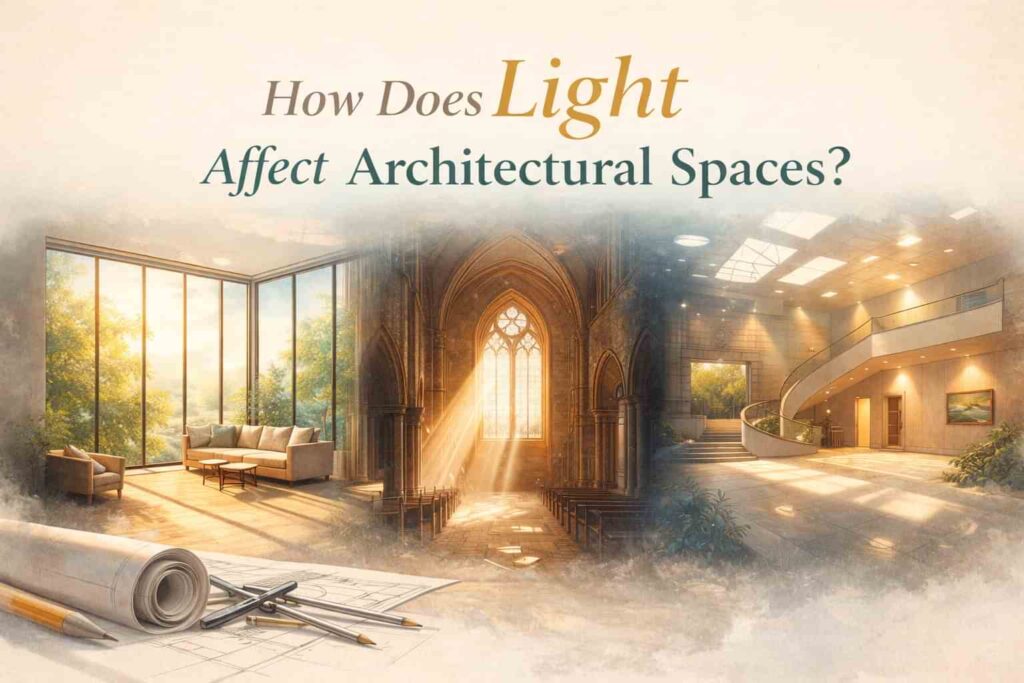
Light is one of the most powerful yet intangible elements in architecture. Unlike walls, floors, or roofs, light has no physical form, yet it profoundly shapes how architectural spaces are perceived, experienced, and remembered. It influences not only visibility but also emotion, orientation, scale, and spatial hierarchy. A well-designed space is often defined as much by how it handles light as by its material or structure.
Architectural design, therefore, is not merely about enclosing space but about choreographing light allowing it to enter, diffuse, reflect, or withdraw in deliberate ways.
Light as a Spatial Organizer
Light has the ability to define and organize space without the need for physical partitions. Brighter areas naturally attract movement and attention, while darker zones suggest privacy or transition. Through controlled lighting, architects can guide occupants intuitively through a building.
Gradations of light help establish spatial hierarchy. For example, a well-lit central space often acts as a focal point, while peripheral areas remain subdued. This hierarchy enhances clarity and legibility within complex architectural layouts.
In spatial planning, light helps to:

Psychological and Emotional Impact of Light
Light directly affects human perception and emotional response. Daylight, in particular, is associated with comfort, alertness, and a sense of connection to the outside world. Spaces flooded with soft natural light tend to feel open, welcoming, and calm, whereas poorly lit environments can feel confined or oppressive.
The color temperature, intensity, and direction of light also play crucial roles. Warm light often evokes intimacy and relaxation, while cooler light enhances concentration and clarity. Architects use these qualities to shape the atmosphere of spaces such as homes, workplaces, religious buildings, and cultural institutions.
“Light creates ambience and feel of a place, as well as the expression of a structure.”
Natural Light and Architectural Form
Natural light is inseparable from architectural form. The size, position, and orientation of openings determine how daylight enters a building and changes throughout the day. Windows, skylights, courtyards, and light wells are not merely functional elements but critical design tools.
The movement of sunlight introduces time as a design dimension. Shadows shift, surfaces transform, and spaces evolve from morning to evening. This dynamic quality gives architecture a sense of life and rhythm.
Design strategies often involve:

Read Also
Light, Shadow, and Materiality
Light reveals material. The texture, color, and depth of architectural surfaces become visible only through their interaction with light. Rough materials produce dramatic shadows, while smooth surfaces reflect light evenly, creating a sense of calm and continuity.
Shadow is equally important. Without shadow, space becomes flat and visually uninteresting. The interplay of light and shadow adds depth, contrast, and character, allowing architecture to be perceived as three-dimensional rather than purely geometric.
Materials respond differently to light:
Artificial Lighting and Spatial Experience
While natural light shapes architecture during the day, artificial lighting defines how spaces function after sunset. Thoughtful artificial lighting design extends the architectural intent rather than overpowering it. Instead of simply illuminating surfaces, good lighting design enhances form, highlights details, and supports human activities.
Layered lighting—combining ambient, task, and accent lighting—allows spaces to adapt to different needs and moods. Artificial light also compensates where natural light is limited, ensuring consistency in spatial quality.
Light as a Cultural and Symbolic Element
Beyond function and perception, light often carries symbolic meaning. In sacred architecture, light has historically been used to express spirituality and transcendence. In civic and cultural buildings, light conveys openness, transparency, and collective identity.
Architects across cultures have used light to communicate values, whether through dramatic shafts of light, controlled darkness, or luminous surfaces. These symbolic uses reinforce architecture’s role as both a physical and cultural artifact.
“Architecture is the learned game, correct and magnificent, of forms assembled in the light.”
— Le Corbusier
Conclusion
Light is not an accessory to architecture—it is a fundamental building material. It shapes space, influences emotion, reveals form, and connects architecture to time and nature. A successful architectural space does not merely contain light; it is designed through light.
Understanding how light affects architectural spaces allows designers to create environments that are not only functional but deeply experiential. When light is treated as an integral part of design thinking, architecture transcends construction and becomes a lived, sensory experience.
References
- Ching, F. D. K. Architecture: Form, Space, and Order
- Rasmussen, S. E. Experiencing Architecture
- Zumthor, P. Atmospheres
- Le Corbusier, Towards a New Architecture