
Technology Driven Approaches to Enhancing Accessibility in Contemporary Architecture

Accessible architecture is a fundamental requirement for inclusive and sustainable built environments. With rapid technological advancements, architects now possess powerful tools to design spaces that respond to the diverse needs of individuals with disabilities. This article explores the role of emerging technologies such as Building Information Modeling (BIM), assistive technologies, smart materials, and artificial intelligence in enhancing accessibility within architectural design.
By integrating technology with universal design principles, contemporary architecture can move beyond regulatory compliance toward genuinely inclusive environments. This article synthesizes existing research, global standards, and practical applications to evaluate how technology is reshaping accessible architecture in the 21st century.
Introduction
Accessibility in architecture is no longer viewed as an optional design consideration but as an ethical, legal, and professional responsibility. According to the World Health Organization, over 1 billion people globally live with some form of disability, making accessibility a critical concern in the built environment (WHO, 2023).
Technological innovation has emerged as a transformative force, enabling architects to anticipate user needs, simulate accessibility outcomes, and implement adaptive design solutions. This article investigates how technology enhances architectural accessibility and evaluates its impact on design processes, building performance, and user experience.
Theoretical Framework: Accessibility and Universal Design
Accessible architecture is rooted in the philosophy of Universal Design, defined as the creation of environments usable by all people, to the greatest extent possible, without adaptation (Mace, 1998).
“Universal design is not a special requirement for the benefit of a few, but a fundamental condition of good design.”
— Ronald L. Mace
Global regulations such as the Americans with Disabilities Act (ADA) and accessibility guidelines in building codes have set minimum standards. In India CPWD handbook on accessibility and barrier-free design gives standard for accessibility in buildings. However, technology enables architects to exceed these standards by offering data-driven, user-centered solutions.
Digital Design Tools and Accessibility
1 Building Information Modeling (BIM)
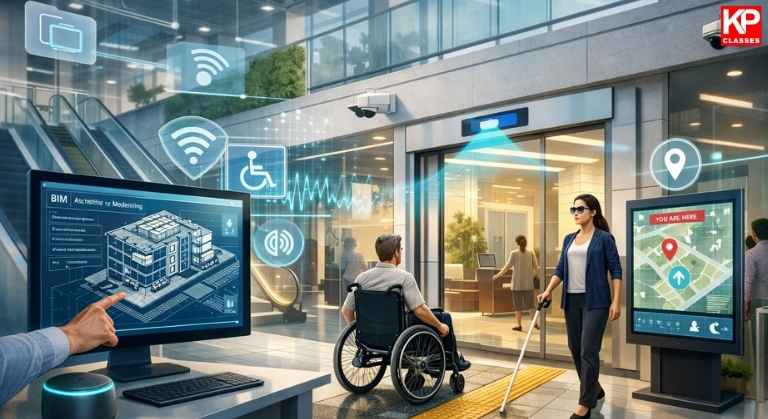
BIM allows architects to digitally simulate building performance, including accessibility compliance. Parameters such as ramp gradients, turning radii for wheelchairs, tactile flooring, and clearances can be analyzed during the design phase itself.
Research by Eastman et al. (2018) indicates that BIM-based accessibility analysis reduces post-construction modifications by nearly 40%, leading to cost-effective inclusive design.

2 Virtual Reality (VR) and User Simulation
VR technology enables designers to experience spaces from the perspective of users with mobility, visual, or auditory impairments. This empathetic simulation fosters informed design decisions and enhances spatial usability.
Smart Technologies and Assistive Systems
1 Internet of Things (IoT) in Accessible Buildings
Smart sensors, voice-activated controls, and automated systems significantly improve building accessibility. Features such as automatic doors, adaptive lighting, and real-time navigation systems assist users with limited mobility or sensory impairments.
“Smart environments have the potential to restore independence to users traditionally excluded by conventional design.”
— Steinfeld & Maisel (2012)
2 Assistive Technologies
Assistive devices integrated into architectural spaces—such as tactile navigation paths, audio wayfinding systems, and AI-based recognition tools—enhance spatial orientation and safety for visually impaired users.

Smart Materials and Adaptive Architecture
Innovations in material science contribute to accessibility through responsive environments. Examples include:
- Shape-memory alloys for adaptive handrails
- Anti-slip intelligent flooring with sensory feedback
- Electrochromic glass to reduce glare for visually sensitive users
These materials enable buildings to respond dynamically to user needs, reinforcing inclusivity.
Challenges and Ethical Considerations
Despite technological advantages, challenges remain:
- High implementation costs
- Lack of technological literacy among practitioners
- Over-reliance on automation
Ethically, architects must ensure that technology supplements human-centered design rather than replacing it. Accessibility should remain a right, not a premium feature.
Implications for Architectural Education and GATE Aspirants
For GATE Architecture aspirants, understanding the intersection of technology and accessibility is increasingly important. Topics such as Universal Design, smart buildings, and digital workflows are frequently tested in GATE examinations and are vital for contemporary practice.
We at KP GATE Classes emphasize conceptual learning to prepare students for both competitive exams and professional challenges in inclusive architecture.
Conclusion
Technology has redefined the scope of accessible architecture by enabling predictive design, adaptive environments, and user-centric solutions. When integrated thoughtfully with universal design principles, technological tools can transform buildings into inclusive ecosystems. As architectural practice evolves, accessibility must be embedded at the core of technological innovation rather than treated as a secondary concern.
References
- World Health Organization. (2023). Disability and Health. WHO Publications.
- Eastman, C., Teicholz, P., Sacks, R., & Liston, K. (2018). BIM Handbook. Wiley.
- Mace, R. L. (1998). Universal Design in Housing. Center for Universal Design.
- Steinfeld, E., & Maisel, J. (2012). Universal Design: Creating Inclusive Environments. Wiley.
- Americans with Disabilities Act. (1990). ADA Accessibility Guidelines. U.S. Department of Justice.