
Varanasi’s Ghats: Architectural Marvels Along the Ganges River

Stretching gracefully along the banks of the sacred Ganges River, the ghats of Varanasi form one of the most continuous and complex riverfront architectural landscapes in the world. More than a collection of steps leading to water, these ghats represent centuries of architectural evolution, religious belief, social life, and urban adaptation.
Built incrementally over time, Varanasi’s ghats are not the result of a single plan or era. Instead, they embody a layered architectural narrative shaped by rulers, merchants, pilgrims, and local communities. Together, they create a living edge between the city and the river where ritual, architecture, and daily life merge seamlessly.
The Urban Role of Ghats in Varanasi
Architecturally, the ghats function as transitional spaces between land and water. They mediate between the dense urban fabric of the city and the constantly shifting level of the river. This threshold condition gives the ghats a unique spatial character, where movement, pause, gathering, and ritual coexist.
Unlike modern waterfronts designed primarily for leisure, Varanasi’s ghats serve multiple overlapping purposes. They act as:
This multifunctionality has directly influenced their architectural form, resulting in stepped terraces, platforms, shrines, pavilions, and attached residential structures.

Architectural Form and Spatial Composition
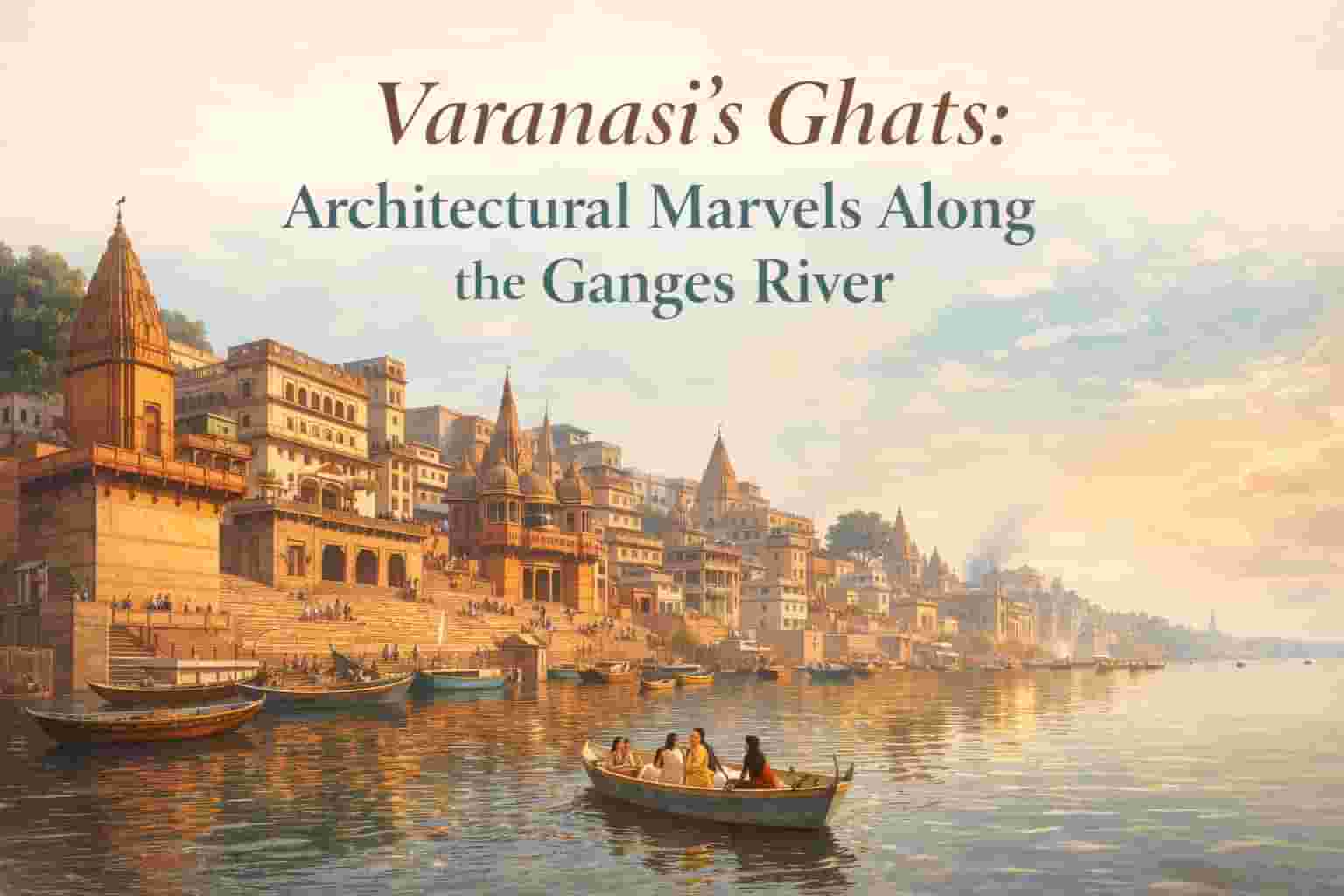
Most ghats follow a stepped geometry that responds to seasonal fluctuations of the river. Broad stone steps descend gradually, allowing access during both high and low water levels. These steps are not uniform; they vary in width, height, and rhythm, creating a dynamic and human-scaled experience.
Behind the steps rise layers of built form—retaining walls, colonnaded pavilions, temples, palaces, and residential facades. The architecture is predominantly masonry-based, using locally available stone and lime mortar, contributing to both durability and visual continuity.
Key architectural elements commonly found along the ghats include:
Materiality and Construction Techniques
Stone is the dominant material of the ghats, chosen for its resistance to water, erosion, and time. Sandstone and other regional stones have been used extensively, often left exposed, allowing texture and aging to become part of the architectural expression.
Construction techniques emphasize mass and gravity. Thick retaining walls stabilize the riverbank, while stepped platforms distribute loads efficiently. Over centuries, these techniques have proven resilient, surviving floods, erosion, and continuous use.
The restrained use of ornamentation ensures that architecture does not overpower ritual activity. Instead, form, proportion, and repetition create visual harmony along the riverfront.

Read Also
Ghats as Cultural and Ritual Architecture
Each ghat in Varanasi carries a distinct identity shaped by its primary use. Some are associated with daily rituals and festivals, while others are dedicated to specific rites such as cremation or meditation. Architecture subtly reinforces these functions through spatial arrangement and symbolism.
For example:
This functional differentiation ensures that architecture supports ritual without becoming intrusive.
Visual Rhythm Along the Riverfront
Viewed from the river, the ghats present a continuous yet varied skyline. The repetition of steps establishes rhythm, while temples, domes, and palatial facades introduce vertical accents. This balance between uniformity and variation is what gives the ghats their remarkable visual coherence.
The riverfront elevation acts almost like a long architectural section, revealing how buildings stack vertically—from water-level platforms to upper terraces and urban streets beyond.
“The ghats of Varanasi are not monuments frozen in time, but living architecture shaped by ritual and repetition.”
Environmental Response and Sustainability
Long before contemporary discussions on sustainable urbanism, the ghats demonstrated climate-responsive design. Their stepped form allows flexible use during seasonal changes, while stone construction helps regulate temperature. The close relationship between built form and natural cycles reflects an intuitive understanding of environmental forces.
By accommodating change rather than resisting it, the ghats offer valuable lessons in resilient waterfront architecture.
Conclusion
Varanasi’s ghats are far more than scenic river steps—they are a sophisticated architectural system shaped by history, belief, and environment. Their strength lies not in monumental scale, but in continuity, adaptability, and human engagement.
As architectural artifacts, the ghats demonstrate how urban edges can become active cultural landscapes rather than rigid boundaries. They remind us that architecture achieves its greatest power when it responds to place, time, and human ritual with sensitivity and restraint.
References
- Havell, E. B. Benares: The Sacred City
- Michell, G. The Hindu Temple: An Introduction to Its Meaning and Forms
- Eck, D. L. Banaras: City of Light
- Tillotson, G. H. R. Indian Architecture and the Riverfront Tradition