
Types of Arches in Architecture: Form, Structure, and Historical Logic

Introduction
The arch is one of the earliest and most intellectually significant structural inventions in architectural history. Long before the development of modern structural systems, builders understood that curved forms could span openings more efficiently than straight members. By redirecting vertical loads into compressive forces along a curved path, arches made it possible to construct bridges, gateways, halls, and monuments of remarkable durability and scale.
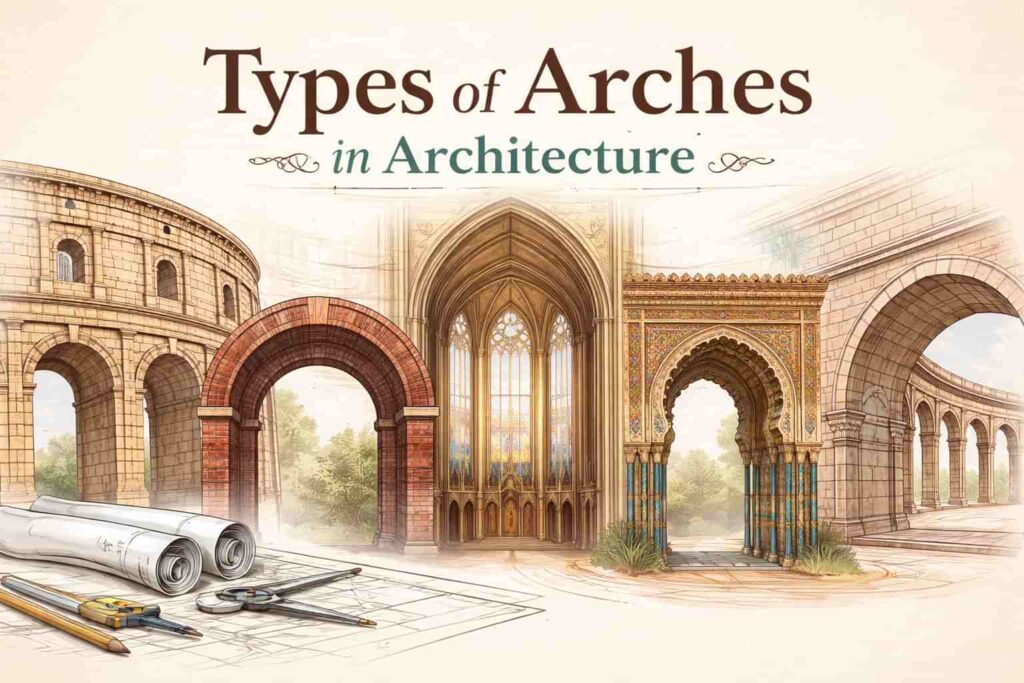
Across civilizations, the form of the arch evolved not only due to structural necessity but also as a response to material availability, construction techniques, cultural expression, and aesthetic intention. Understanding the types of arches therefore requires looking beyond geometry and considering how form, force, and history intersect.

Structural Principle of an Arch
An arch works predominantly in compression. Unlike beams, which experience bending and tension, an arch transforms applied loads into compressive stresses that travel along its curve and are transferred safely to the supports. This behavior explains why arches were extensively used in stone and brick construction, materials that perform exceptionally well under compression.
Every arch consists of wedge-shaped units known as voussoirs, arranged so that each unit presses against the next. At the crown of the arch lies the keystone, which locks the entire system into equilibrium. The stability of the arch depends on accurate geometry, proper centering during construction, and adequately designed abutments capable of resisting horizontal thrust.
“The arch is the natural form of masonry construction, because it works entirely in compression.”
— Francis D.K. Ching

Classification of Arches Based on Shape
Semi-Circular Arch
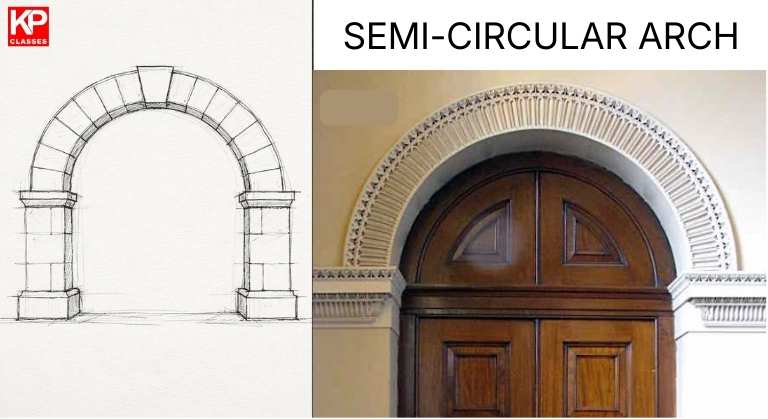
The semi-circular arch is one of the most ancient and structurally direct forms. Its geometry is based on a perfect half circle, resulting in a symmetrical distribution of forces. This type of arch was extensively used in Roman construction, particularly in aqueducts, amphitheaters, and monumental gateways.
Structurally, the semi-circular arch generates significant horizontal thrust at its supports, requiring thick piers or massive abutments. While structurally robust, this characteristic limits its use in slender or lightweight constructions.
Key characteristics include:
Segmental Arch
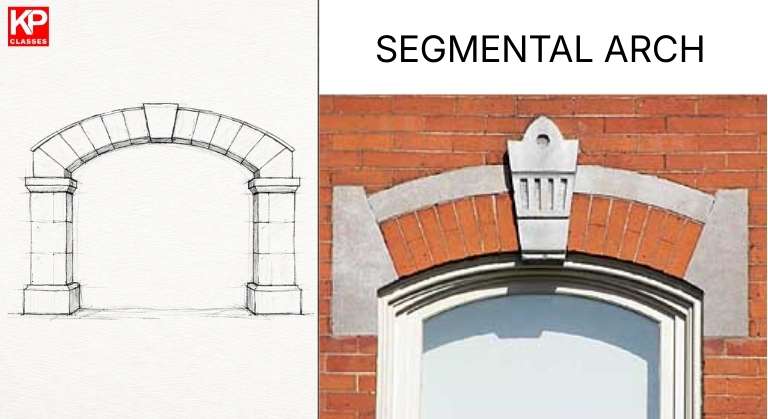
A segmental arch is formed from a segment of a circle smaller than a semicircle. Its flatter profile allows it to span openings with reduced rise, making it suitable for spaces where height is limited.
Compared to semi-circular arches, segmental arches produce lower horizontal thrust, though they still require careful support design. They are commonly found in residential and institutional buildings, particularly above doors and windows.
Notable features:
Pointed Arch
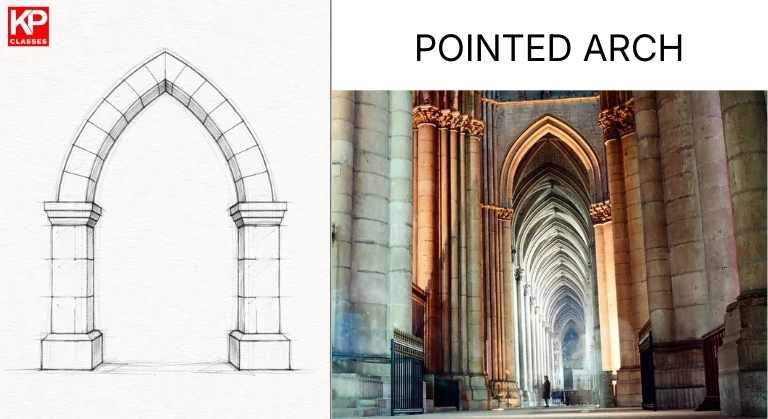
The pointed arch represents a major structural and architectural advancement. Formed by the intersection of two arcs, it directs a greater portion of the load vertically downward rather than laterally. This property allows for taller, more slender constructions and thinner supporting elements.
The widespread use of pointed arches transformed medieval architecture, enabling unprecedented building heights and expansive interior spaces. Beyond structural efficiency, the pointed arch also introduced a strong vertical visual emphasis.
“The pointed arch was not a stylistic accident, but a logical structural evolution.”
— Eugène Viollet-le-Duc
Horseshoe Arch
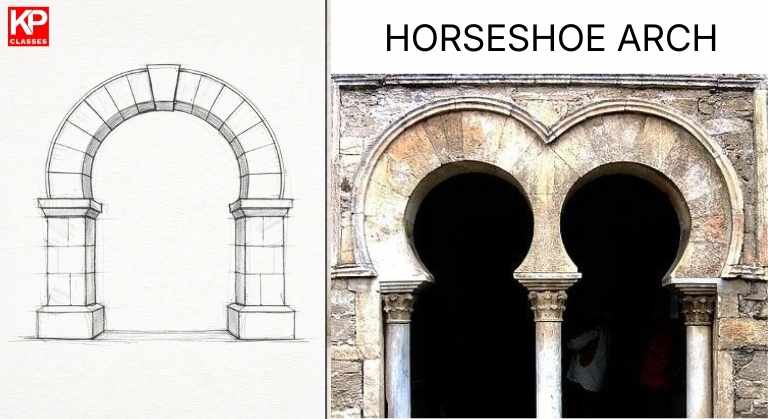
The horseshoe arch extends beyond the diameter of its supporting columns, creating a distinctive enclosed profile. This form is closely associated with Islamic and Moorish architecture, where it served both structural and symbolic roles.
Although not the most efficient in terms of load distribution, the horseshoe arch is valued for its strong visual identity and rhythmic repetition in arcades and prayer halls.
Typical characteristics:
Also Read
Elliptical Arch
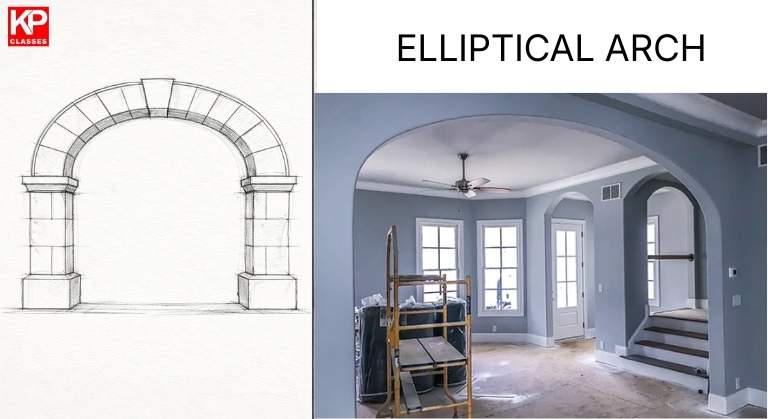
Elliptical arches are based on elliptical geometry rather than circular arcs. They provide a smooth, elongated curve that is visually refined but structurally complex. The construction of elliptical arches requires precise centering and skilled craftsmanship, making them less common in traditional masonry.
These arches are often used in bridges, palaces, and formal halls where visual elegance is prioritized alongside structural performance.
Classification Based on Structural Behavior
Beyond shape, arches can also be understood through the way they respond to loads and support conditions. This classification is particularly relevant in large-span and bridge construction.
- Fixed arches are rigidly connected at both supports, limiting rotation and displacement.
- Two-hinged arches allow rotation at the supports, reducing internal stresses due to temperature variation.
- Three-hinged arches include an additional hinge at the crown, making them highly adaptable to settlement and differential movement.
Each system reflects a different balance between rigidity and flexibility, chosen according to site conditions and functional requirements.
Materials Used in Arch Construction
The material of an arch significantly influences its form and behavior. Traditional stone arches rely entirely on compressive strength and precise craftsmanship. Brick arches, being lighter and more modular, allow greater flexibility in construction and detailing.
With the advent of reinforced concrete and steel, arches could span much larger distances with slimmer profiles. Modern arches often combine structural efficiency with expressive architectural form, continuing the relevance of this ancient system in contemporary design.
Historical Significance and Architectural Expression
Throughout history, the arch has acted as both a structural solution and a powerful architectural symbol. Roman arches conveyed permanence and authority, Gothic arches expressed aspiration and lightness, while Islamic arches emphasized rhythm and ornamentation.
“Architecture is the thoughtful making of space, and the arch is one of its most thoughtful inventions.”
— Louis Kahn
Conclusion
The study of arches reveals how architecture balances form, force, and meaning. Each type of arch reflects a specific response to material constraints, structural logic, and cultural context. Even in an era dominated by advanced engineering systems, arches remain relevant due to their efficiency, durability, and timeless architectural appeal.
A deep understanding of arches allows architects to appreciate not only how buildings stand, but why they take the forms they do.
References
- Ching, F. D. K. Building Construction Illustrated
- Fletcher, Banister. A History of Architecture
- Viollet-le-Duc, E. Lectures on Architecture
- Unwin, W. The Art of Building in Ancient and Modern Times